

Dog Bites on Delivery Drivers in Memphis: What Tennessee Law Says About Who Pays

Delivering packages, food, or mail means approaching dozens of unfamiliar front doors every day. Most of the time nothing happens. But when a dog charges through an open door or meets you at the end of a driveway without warning, what seemed like an ordinary workday can turn into an emergency room visit, weeks off work, and a recovery that takes far longer than the attack itself.
Dog bites on delivery workers are more common than most people realize. According to the National Dog Bite Prevention Week Coalition, delivery drivers were the third most common group to suffer dog bites in 2020, following children and the elderly. UPS alone reports an average of 900 aggressive dog incidents resulting in injuries each year. The numbers have only grown since then as home delivery volumes have kept climbing.
If you were bitten while working a route in Memphis, Jackson, or anywhere in West Tennessee, you likely have legal options against the dog’s owner and possibly through your employer’s insurance as well. The dog bite attorneys at Greer Injury Lawyers have represented injured workers across Tennessee since 1986, and we understand how these claims work and where dog owners try to avoid responsibility.
Why Delivery Drivers Are Especially Vulnerable
A delivery driver’s job requires walking onto private property at addresses where no one is expecting you. You may ring the bell and step back, or simply leave a package at the door, but in both cases you are within reach of any dog that lives at or near that property.
As delivery drivers frequently find themselves at the doorstep of homes — often unannounced — the potential for dog bites increases significantly. Dogs are territorial by nature, and a stranger in a uniform approaching their home can trigger an aggressive response even in animals that have never shown aggression before.
Individuals who have to wait on a porch or front step for the owner to sign for a package or provide payment tend to have the greatest risk for dog bites. Time pressure from delivery schedules makes it harder to pause and assess a situation. And unlike someone visiting a home voluntarily, a delivery driver often cannot simply choose not to approach.
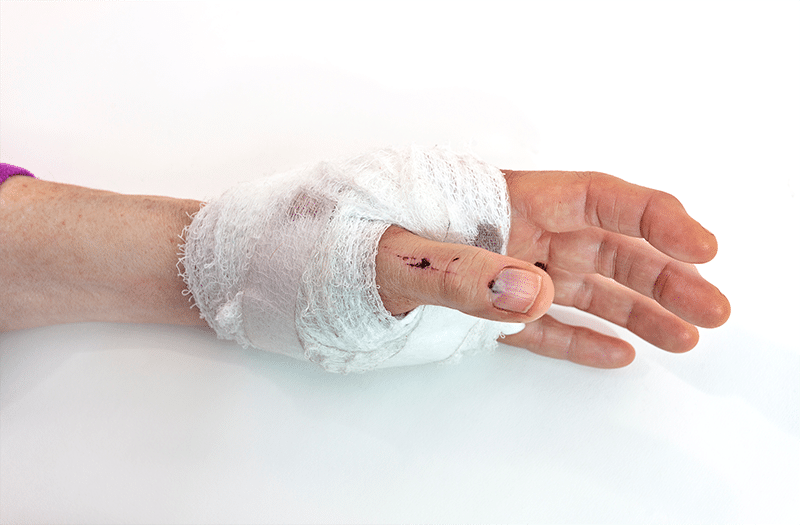
The injuries that result are not minor. Dog bites commonly cause deep puncture wounds, nerve damage, serious infections, and lasting psychological effects including anxiety and fear responses that can interfere with your ability to do your job long after the wound has healed.
Tennessee Dog Bite Law and What It Means for Delivery Workers
Tennessee’s dog bite statute, T.C.A. section 44-8-413, is one of the more distinct in the country because it blends two approaches: strict liability and the “one-bite rule,” depending on where the attack occurs.
Strict Liability When You’re Lawfully on the Property
Under T.C.A. 44-8-413, a dog owner has a duty to keep that dog under reasonable control at all times and to keep that dog from running at large. A person who breaches that duty is subject to civil liability for any damages suffered by a person who is injured by the dog while in a public place or lawfully in or on the private property of another. The owner may be held liable regardless of whether the dog has shown any dangerous propensities or whether the dog’s owner knew or should have known of the dog’s dangerous propensities.
This matters a great deal for delivery drivers. Under Tennessee premises liability law, a property owner owes a duty of care to anyone lawfully on the property, including invitees like delivery drivers, postal workers, and contractors. When you approach a door to drop off a package or wait for a signature, you are there with an implied invitation tied to your work. You are not a trespasser, and that status alone removes one of the most common defenses dog owners try to raise under T.C.A. section 44-8-413.
In plain terms: if a dog bites you while you are making a lawful delivery at a home or business in Tennessee, and the dog’s owner failed to keep it under control, you generally do not have to prove the dog had a history of aggression. The bite itself can be enough to establish liability.
The Residential Exclusion — A Complication Worth Understanding
If the bite occurs on property owned by the dog owner, the victim must prove the elements of the one-bite rule, namely that the dog owners “knew, or should have known, of their dog’s dangerous propensities.” Tennessee is the only state that has a “residential exclusion” in its dog liability statute. The exclusion leaves over 50% of otherwise-qualified victims in Tennessee without an automatic strict liability claim.
This is the part of Tennessee law that catches many people off guard. If a dog bites you on the dog owner’s own residential property, you face a harder burden of proof. You would need to show the owner had reason to know the dog was dangerous, whether through a prior bite, complaints from neighbors, or the dog’s history of threatening behavior.
An experienced dog bite attorney can help you build that case. Evidence of prior incidents, animal control records, neighbor accounts, and even things like a “Beware of Dog” sign on the property can all go toward proving the owner had notice. These cases are winnable, but they require investigation that starts as soon as possible after the attack.
Statute of Limitations: One Year in Tennessee
For personal injury lawsuits including dog bite claims, a plaintiff must file their lawsuit within one year of being injured by the dog. In almost all personal injury cases the one-year statute of limitations will apply, and if you fail to file your lawsuit within that time you will be permanently barred from filing your lawsuit.
Tennessee’s one-year deadline is shorter than most states. Do not wait to speak with an attorney.
Workers’ Compensation and Personal Injury: You May Have Both Options
One question delivery drivers often ask is whether they should file a workers’ compensation claim or a personal injury lawsuit. In many cases, the answer is both, and how that plays out depends on your employment status.
If You’re a Direct Employee
If you work directly for a company like UPS, FedEx, or a local courier service as a full employee, you are likely covered by your employer’s workers’ compensation insurance. Companies like UPS are well aware of the dangers that aggressive dogs pose to full-time employees, part-time employees, seasonal workers, and independent contractors. FedEx also provides workers’ compensation to their employees.
Workers’ compensation covers your medical bills and a portion of your lost wages, regardless of fault. The tradeoff is that it typically does not compensate for pain and suffering. That gap is where a personal injury claim against the dog’s owner becomes relevant.
A realistic scenario is that you file a workers’ compensation claim with your employer for coverage of medical bills and lost wages, then also sue the dog’s owner to recover damages that workers’ compensation does not cover, including pain and suffering.
If You’re an Independent Contractor
Many Amazon Flex drivers, DoorDash drivers, and gig delivery workers are classified as independent contractors rather than employees. If you are an independent contractor, you are typically not eligible for the company’s workers’ compensation coverage. In that situation, your primary path to compensation is a direct personal injury claim against the dog owner.
Most delivery workers are within their rights to sue a dog owner whose animal bites them. The dog owner’s homeowner’s insurance policy should anticipate and provide compensation for these risks. Most homeowner’s and renter’s insurance policies include liability coverage that applies to dog bite injuries, even when the victim was a delivery driver.
Who Else Could Be Liable?
In some cases, liability extends beyond the dog’s owner directly.
Landlords and property managers may share liability if they knew a tenant’s dog was dangerous and failed to act. This typically requires showing the landlord had actual knowledge of the dog’s prior behavior and took no reasonable steps to address the risk.
Property owners who control access to a business or multi-tenant property may also face liability if the attack happens on common areas where delivery drivers are regularly present.
These situations are fact-specific, and the law in this area continues to develop. If you were attacked at a rental property or apartment complex, it is worth discussing the full picture with an attorney before assuming only one party bears responsibility.
What to Do After a Dog Bite on the Job
The steps you take in the hours and days after an attack directly affect both your physical recovery and your legal claim.
Get medical attention the same day. Dog bites carry a serious risk of infection, including from bacteria like Pasteurella and Capnocytophaga. If the dog’s vaccination history is unknown, rabies evaluation is also necessary. A same-day medical visit creates documentation that ties your injuries directly to the attack.
Report the incident to animal control. Filing a report with Memphis Animal Services or your local animal control agency creates an official record and may trigger an investigation into the dog’s history. That history can become important evidence.
Report to your employer immediately. Workers’ compensation claims have strict reporting deadlines. Even if you are not sure whether you qualify, report the injury to your employer the same day or as soon as physically possible.
Document everything you can. Photograph your injuries before treatment, photograph the property and the location of the attack, and note the address and any information about the dog or the owner. If anyone witnessed the attack, get their contact information.
Do not give a recorded statement to any insurance company without speaking to an attorney first. Adjusters from the dog owner’s homeowner’s insurer may contact you quickly. What you say in those early conversations can be used to reduce or deny your claim.
Damages You Can Recover in a Tennessee Dog Bite Case
When a dog bite claim succeeds in Tennessee, victims can recover both economic and non-economic damages.
Economic damages include all past and future medical expenses, lost wages during recovery, and any long-term costs related to the injury such as physical therapy, reconstructive care for scarring, or psychological counseling. If the bite affects your ability to return to delivery work or any other occupation, lost earning capacity may also be part of the claim.
Non-economic damages include compensation for physical pain, emotional suffering, and the impact the injury has had on your daily life. For delivery workers, a dog bite can create lasting anxiety about approaching homes on a route, a fear that directly affects job performance and quality of life.
The average workers’ compensation claim related to a dog bite totals $33,230, and that figure does not include pain and suffering or the full value of a personal injury claim against the dog owner. Combined claims often result in significantly higher recovery.
Frequently Asked Questions About Dog Bites on Delivery Drivers in Tennessee
Can I sue the dog owner if I was bitten at their home?
Yes, but the legal standard depends on where on the property the bite occurred. If you were bitten in a publicly accessible area or while lawfully making a delivery, strict liability under T.C.A. section 44-8-413 may apply and you would not need to prove the owner knew the dog was dangerous. If the bite happened deeper on residential property, you may need to show the owner had prior knowledge of the dog’s dangerous behavior.
What if the dog had never bitten anyone before?
Tennessee’s strict liability statute does not require a prior bite to establish liability when the attack happens in a public place or while the victim is lawfully on private property. The owner’s failure to keep the dog under reasonable control is enough. The “first bite” defense carries more weight only under the residential exclusion, which applies to attacks on the dog owner’s own property.
Does it matter that I was there for a delivery and not a personal visit?
No, it works in your favor. A delivery driver arriving at a property has an implied lawful invitation to be there. That status as a lawful visitor supports a claim under both Tennessee’s dog bite statute and general premises liability principles. You are not a trespasser, and the owner owed you a duty of care.
Can I file both a workers’ comp claim and a lawsuit against the dog owner?
In many cases, yes. Workers’ compensation covers medical bills and lost wages but generally does not compensate for pain and suffering. A separate personal injury claim against the dog owner can fill that gap. An attorney can help you structure both claims to maximize your total recovery without jeopardizing either one.
How long do I have to file a claim in Tennessee?
One year from the date of the bite under T.C.A. section 28-3-104. This is one of the shortest personal injury deadlines in the country. Do not wait.
What if the owner’s dog is covered by their homeowner’s insurance?
Most standard homeowner’s and renter’s insurance policies include liability coverage for dog bites. Filing a claim against that policy is often the first step in recovering compensation. Insurance companies in these situations will work to minimize what they pay, which is one reason to have an attorney representing your interests early in the process.
Talk to a Memphis Dog Bite Attorney Today
If you were bitten by a dog while making a delivery in Memphis, Jackson, or anywhere across West Tennessee, the attorneys at Greer Injury Lawyers can help you understand your options and pursue every dollar you are owed. We handle dog bite cases on a contingency basis, which means you pay no fees unless we win your case.
Learn more about how our firm handles dog bite cases, or contact us directly for a free case evaluation. Call Greer Injury Lawyers today or contact us online to schedule a free consultation.
This article is for general informational purposes only and does not constitute legal advice. Tennessee law cited includes T.C.A. section 44-8-413 and T.C.A. section 28-3-104. Laws change; consult a licensed Tennessee attorney for advice specific to your situation.

For over 20 years, Thomas has dedicated his career to representing victims of serious personal injury, wrongful death, and professional negligence in Tennessee, Arkansas, and Mississippi. Thomas comes from a family of trial lawyers. His passion is being in the courtroom, where he has secured record-breaking verdicts for his clients.
Read more about Thomas R. Greer