
School Zone Pedestrian Accidents in Tennessee: What Parents Should Know
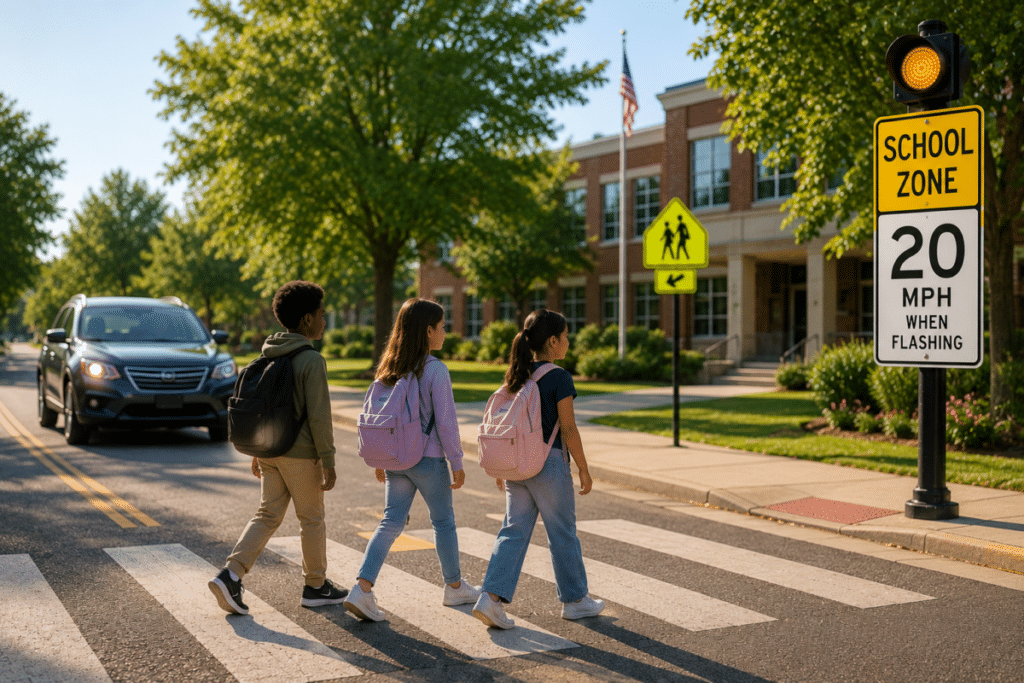
School buses are back on the road, crossing guards are back at their posts, and sidewalks around Tennessee schools are filling up with kids walking, biking, and being dropped off by parents in a hurry to get to work. It is also one of the more dangerous times of year to be a child near traffic.
National crash data shows more school-age pedestrians are killed between 3 p.m. and 4 p.m. than during any other hour of the day, the exact window when school lets out and streets around campus fill with cars. Research from the AAA Foundation for Traffic Safety found that a pedestrian’s average risk of death climbs from about 25% at 32 miles per hour to 50% at 42 miles per hour, which is exactly why Tennessee law slows traffic down near schools in the first place.
If your child was hurt by a driver near a school in Memphis, Jackson, Nashville, or anywhere else in Tennessee, Greer Injury Lawyers can help you understand what the law requires of drivers in those zones and what your family’s legal options look like. Call 901-680-9777 for a free case evaluation.
Why School Zones Carry So Much Risk
Only about 41% of public schools nationally report having a crossing guard stationed on the streets around campus, according to National Center for Education Statistics data released in 2024, which leaves a majority of schools with real gaps in supervised crossings during arrival and dismissal. Combine that with parents running late, rideshare and delivery drivers unfamiliar with a school’s layout, and kids who dart between parked cars, and the risk compounds quickly.
Speeding remains a major factor. Nationally, speeding-related crashes accounted for close to 29% of all traffic fatalities in 2022, and that risk concentrates around schools during the specific hours when children are present on foot.
Tennessee’s School Zone Speed Laws
Under T.C.A. § 55-8-152, Tennessee municipalities are authorized to set special reduced speed limits on streets adjacent to school grounds, generally within a set distance of the school and only during the periods before and after school hours when children are actually going to or coming from class. These reduced limits must be enacted following an engineering study, cannot be set below 15 miles per hour, and only take legal effect when proper signage and an active warning flasher are in place.
If a local government has not set a special school zone speed limit through this process, Tennessee law still steps in: driving faster than 15 miles per hour while passing a school during the 40 minutes before school opens or the 40 minutes after it closes, while children are actually present, is treated as prima facie evidence of reckless driving. In practice, that means a driver caught speeding past a school during those windows starts from a legal presumption of recklessness that they would have to rebut in court.
Crosswalks, Buses, and Right-of-Way Rules
Under T.C.A. § 55-8-134, drivers must generally yield, slowing or stopping as needed, to a pedestrian in a marked or unmarked crosswalk. In a marked school zone with an active warning flasher, the law goes further: the driver must come to a full stop, not just yield, and remain stopped until the pedestrian has completely crossed. Tennessee also bars a driver from passing another vehicle that has stopped for a pedestrian, a rule aimed at preventing “multiple threat” collisions where a second car strikes a child a first driver had already seen and stopped for. Separately, T.C.A. § 55-8-136 imposes a general duty on every driver to exercise due care to avoid colliding with a pedestrian, and Tennessee courts have recognized that this duty calls for extra caution when the pedestrian is a child.
Tennessee also regulates how drivers must behave around stopped school buses under T.C.A. § 55-8-151, requiring traffic in both directions on most roads to stop while a bus is loading or unloading with its lights activated. Violating this rule is treated seriously by Tennessee courts specifically because so many child pedestrian deaths happen not on the bus, but in the moments right around it.
Distracted Driving Near Schools
Tennessee’s Hands-Free Law, enacted in 2019 under Public Chapter 412, makes it illegal to hold a phone while driving anywhere in the state, and the Tennessee Highway Safety Office specifically calls out school zones as an area of heightened enforcement. A driver glancing at a phone for even a few seconds while approaching a crosswalk full of kids is exactly the scenario this law was written to prevent.
Who Can Be Held Liable for a School Zone Accident
In most cases, the driver who struck the child bears primary responsibility, and Tennessee’s school zone statutes give an injured family a strong evidentiary foundation. When a driver violates a safety statute like the school zone speed limit or the stopped-bus law, and that violation causes an injury to someone the law was designed to protect, Tennessee courts can treat the statutory violation as evidence of negligence, sometimes called negligence per se, rather than requiring the family to prove carelessness from scratch.
Other parties can share liability depending on the facts. If the driver was working, making deliveries, or driving for a rideshare platform at the time of the crash, their employer may bear responsibility under vicarious liability principles. If a school district’s own bus driver or contracted transportation provider caused the crash, the claim is governed by the Tennessee Governmental Tort Liability Act. Claims under this Act still generally follow the same 12-month filing deadline as an ordinary injury claim, and Tennessee courts have held that the minor tolling rule under T.C.A. § 28-1-106 applies to these claims, as well. What differs is the process itself: GTLA claims are typically decided by a judge rather than a jury and are subject to statutory damage caps that don’t apply to claims against a private driver.
Filing a Claim on Behalf of an Injured Child in Tennessee
Tennessee’s personal injury statute of limitations is generally one year from the date of an injury under T.C.A. § 28-3-104, but T.C.A. § 28-1-106 tolls that clock for minors. In practice, this means the one-year window may not begin running until the child’s 18th birthday, giving the child until their 19th birthday to bring a personal injury claim in their own name.
There is an important wrinkle parents should know about. If medical bills from the accident were billed in a parent’s name, as is typical, the parent’s own claim to recover those specific expenses is generally still subject to the standard one-year deadline running from the date of the accident, separate from the child’s own tolled claim for pain and suffering and other damages. Waiting until a child turns 18 to address the medical expense portion of a claim can mean losing the ability to recover it.
Tennessee also follows a modified comparative fault rule, meaning any recovery can be reduced by the injured party’s own percentage of fault, and is barred entirely if that fault reaches 50%. Courts applying comparative fault to a child pedestrian generally account for the child’s age and maturity when assessing what a reasonable child of similar age would have understood about traffic danger, which is a very different standard than the one applied to an adult.
What to Do If Your Child Is Hurt Near a School
Get medical care immediately, even if the injury looks minor at first. Get the responding officer’s name and the crash report number, and if you’re able, photograph the scene, the school zone signage, and any flashers or crossing guard positioning. Get contact information for witnesses, teachers, or staff who saw what happened. Avoid giving a recorded statement to an insurance adjuster before speaking with an attorney, since early statements are often used later to minimize what a family is owed.
How Greer Injury Lawyers Can Help
Thomas Greer built this firm around direct attorney access and a caseload kept deliberately small enough that families are never treated as a case number. An in-house registered nurse helps families understand a child’s medical records and ongoing treatment needs as a case develops, and every case is prepared as though it is headed to trial from the first phone call.
Past results do not guarantee a similar outcome, and every school zone case depends on its specific facts. But acting quickly to preserve crash reports, witness accounts, and school zone documentation gives a family the strongest possible starting point.
Frequently Asked Questions
How long do parents have to file a claim after a child is hit near a school in Tennessee?
The child’s own claim is generally tolled until their 18th birthday, giving them until age 19 to file. A parent’s separate claim for the child’s medical expenses, however, is typically still subject to the standard one-year deadline from the date of the accident.
What is Tennessee’s school zone speed limit?
If a local government has not set a special school zone speed limit through this process, Tennessee law still steps in: driving faster than 15 miles per hour while passing a school during the 90 minutes before school opens or the 90 minutes after it closes (a shorter 40-minute window applies in a handful of counties under a separate population-based provision), while children are actually present, is treated as prima facie evidence of reckless driving.
Can I sue a school district if a school bus hits my child?
Claims against a school district fall under the Tennessee Governmental Tort Liability Act, which generally follows the same 12-month filing deadline as other injury claims, but comes with different procedural rules, including damage caps and a bench trial rather than a jury trial.
Is a driver automatically at fault for hitting a child in a school zone?
Not automatically, but violating a school zone speed limit or a stopped-bus law can serve as strong evidence of negligence under Tennessee law, shifting the practical burden onto the driver to explain their conduct.
If your child was injured by a driver near a school anywhere in Tennessee, contact Greer Injury Lawyers at 901-680-9777 or visit greerinjurylawyers.com for a free, confidential consultation.

For over 20 years, Thomas has dedicated his career to representing victims of serious personal injury, wrongful death, and professional negligence in Tennessee, Arkansas, and Mississippi. Thomas comes from a family of trial lawyers. His passion is being in the courtroom, where he has secured record-breaking verdicts for his clients.
Read more about Thomas R. Greer